Planning the crossing between Saint Kitts and Nevis
Volcanic terrain distinguishes Saint Kitts from Nevis, while the architecture of Basseterre and Charlestown and former plantations help situate their history. Plan the inter-island crossing separately and verify current services before travelling.
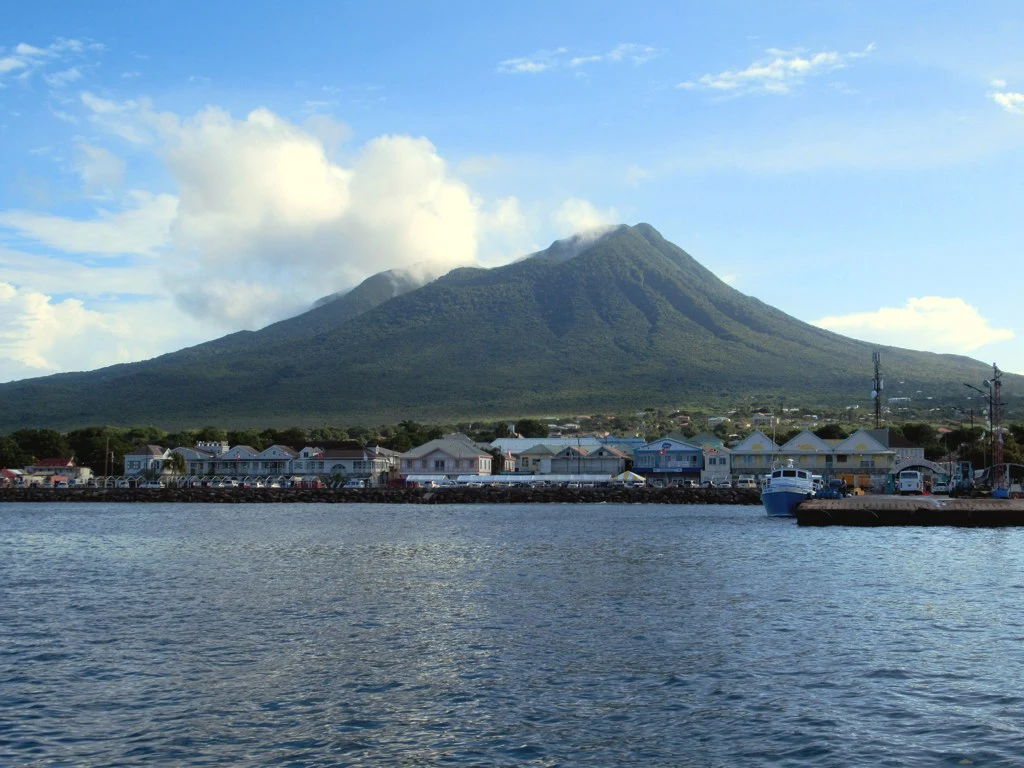
Two distinct terrains to set priorities
Saint Kitts is the larger island, combining a central mountain range with less steep coastal areas where towns like Basseterre are located. Nevis has an almost circular outline, with Nevis Peak occupying its centre; steep slopes give way to a coastal plain and volcanic hills. This contrast helps decide which landscapes and towns to prioritise, but it does not turn the two islands into a single road itinerary. If you visit both, allow time for the transfer and check separately how to continue from each terminal.
Basseterre: an old city with significant post-fire reconstruction
Basseterre is on the western coast of Saint Kitts, and its urban layout follows a grid. Although it is an old city, much of its buildings were constructed after the great fire of 1867. Keeping that date in mind helps distinguish the city's age from the age of each building. Among the places that usually serve as reference points in the centre are Independence Square, The Circus, religious buildings, and the National Museum of Saint Kitts. Confirm before you leave whether the sites you are interested in are open and what their current conditions are.
Charlestown and Nevis's sugar landscape
In Charlestown, stone buildings with balconies and upper wooden floors show features of Georgian architecture from the British colonial period. Outside the urban core, the ruins of former plantation structures, including mills, remain present in the landscape of Nevis. Between the 17th and 19th centuries, almost all of the island's less steep areas were cleared for sugar plantations. Viewing these remnants in that context helps understand that they are not just architectural elements: they refer to an extensive transformation of the territory under a colonial economy.
The inter-island crossing: confirm schedules and connections
Available information describes ferry services between Basseterre and Charlestown, but it does not allow us to assume their schedules, frequencies, or current conditions are valid. Verify the service directly with the operator and confirm the terminal before booking a connection or planning arrival at accommodation. Also review subsequent transport within each island: the existence of a crossing does not guarantee a specific combination of transfers. Leaving margin in the itinerary is a practical decision when the trip depends on services whose operation you must confirm.
Basic references and pending verifications
English is the language recorded for the country, and the Eastern Caribbean dollar (XCD) is its currency. These are useful data for orientation, but they do not replace checking entry requirements, accepted payment methods, or current operational details. If you plan to visit specific places in Basseterre, Charlestown, or former plantations, also confirm opening hours and access with local sources. Distinguishing the two islands from the start allows you to organise heritage and movements without assuming everything fits into a single route.
Sources and references
Hide references
12 references
References consulted during editorial review. Times, requirements and advisories may change: always confirm with the official source.
-
CharlestownLicence: CC BY-SA 4.0 Wikivoyage contributors · Charlestown
-
NevisLicence: CC BY-SA 4.0 Wikivoyage contributors · Nevis
-
Saint KittsLicence: CC BY-SA 4.0 Wikivoyage contributors · Saint Kitts
-
Saint Kitts and NevisLicence: CC BY-SA 4.0 Wikivoyage contributors · Saint Kitts and Nevis
-
Antigua y Barbuda - WikiviajesLicence: CC BY-SA 4.0 Wikivoyage contributors · Antigua y Barbuda - Wikiviajes
-
San Cristóbal y Nieves - WikiviajesLicence: CC BY-SA 4.0 Wikivoyage contributors · San Cristóbal y Nieves - Wikiviajes
-
Basseterre - WikiviajesLicence: CC BY-SA 4.0 Wikivoyage contributors · Basseterre - Wikiviajes
-
San Cristóbal y NievesLicence: CC0 1.0 Wikidata · Q763
-
Saint Kitts and NevisLicence: ODbL 1.0 World countries dataset by mledoze and contributors · ODbL 1.0
-
BasseterreLicence: Datos geográficos bajo CC BY 4.0; requiere atribución a GeoNames. Fuente: GeoNames
-
BasseterreLicence: Datos geográficos bajo CC BY 4.0; requiere atribución a GeoNames. Fuente: GeoNames
-
Saint Kitts and NevisLicence: CC BY-SA 3.0 DBpedia